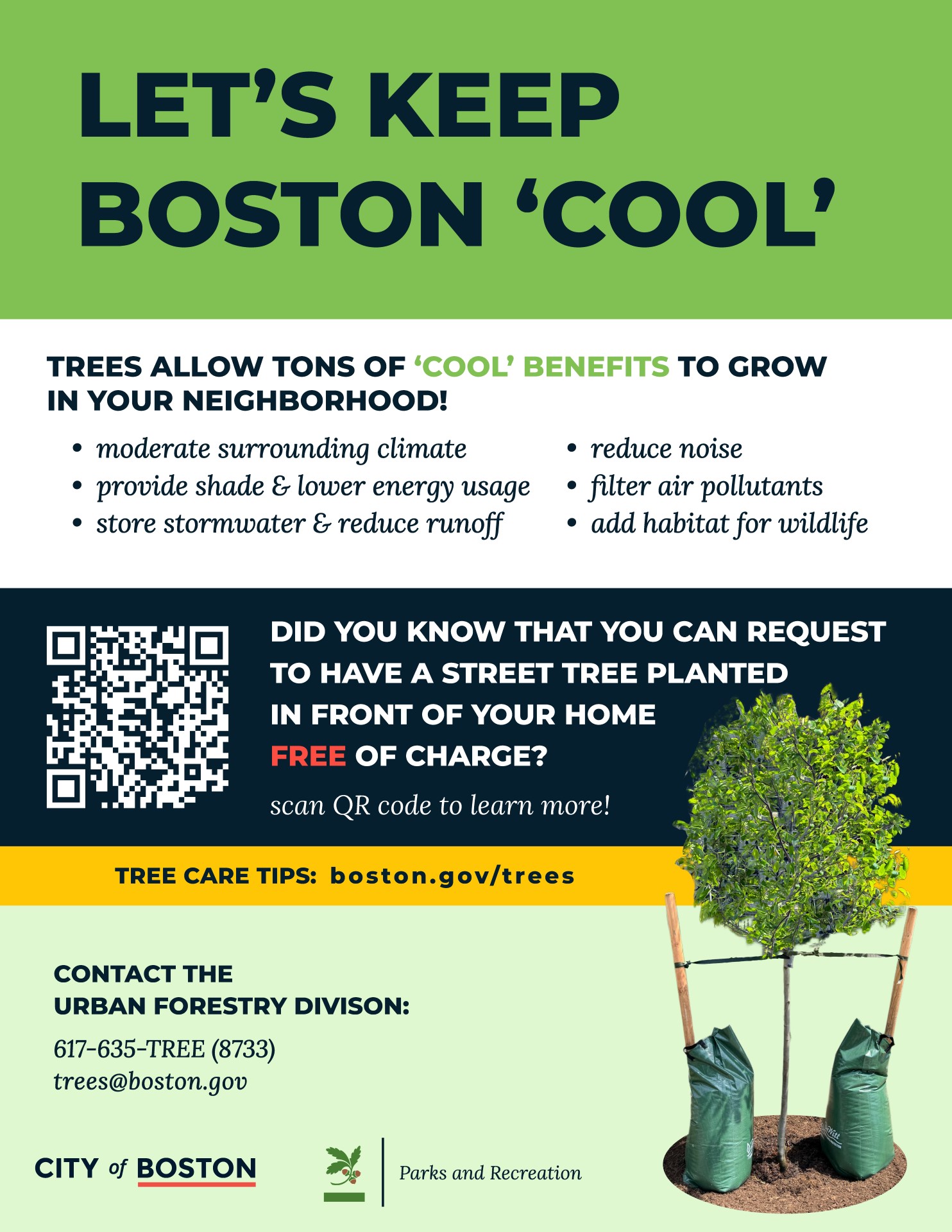
The urban forest is an important part of the City’s landscape. It’s made up of all the trees on public and private land in Boston, along with the City’s shrubs, grasses, ground cover, soil, and waterways.

guide
Urban Forestry
Last updated:
Street Tree Inventory
The Urban Forestry Division is working to maintain updated information on the city’s almost 40,000 street trees. Explore the inventory to learn about trees in your neighborhood and see some of the recent work done by the division.


Street trees in the City of Boston are the Urban Forestry Division’s responsibility. If there is a tree that is too close to your house or the sidewalk, we will gladly prune it back to provide clearance according to City standards.
You can make a 3-1-1 case via app or phone, which creates a permanent record of the request, to inform the Division of your issue. A City arborist will be out to inspect your tree within a few weeks. If the arborist finds your tree needs pruning, it will be put on a list for one of our contractors to prune when they are next scheduled to be in your neighborhood.
It is important to know that Public Shade Trees, including all street trees on City sidewalks, are protected by Massachusetts General Law, Chapter 87. This means that only the Urban Forestry Division and its contractors can prune trees on City sidewalks.
Yes, so long as the pit conforms to our current standards, including ADA compliance and no conflicting underground utilities. A New Tree Request is automatically created after the existing tree is removed.
The Urban Forestry Division plants trees in the Spring (April-June) and Fall (October-December). When we remove a street tree, we do our best to replant it the next possible planting season.
The Urban Forestry Division is committed to expanding Boston’s urban canopy. We want to plant as many new trees as we can, though we have a few criteria when it comes to planting a new tree where there was not one before. Primarily, it is the Division’s policy to have the abutting property owner make a New Tree Request before we cut a new tree pit in the sidewalk.
If you are the property owner, all you need to do is create a New Tree Request case in 3-1-1. This can be done via app or phone.
To get more trees on your block, consider talking to your neighbors and sharing the downloadable flyer below, detailing benefits of trees and instructions for requesting a new tree.
Street trees in the public right of way are owned and maintained by the City of Boston Urban Forestry Division. The City’s contractor that conducts planting of street trees also waters them for the first two years after planting. The watering bags will be filled by the contractor once every two weeks during warm weather months.
While this provides a basic level of care, we welcome residents to be stewards of their leafy neighbors! It is not expected of residents, but those who wish to water sidewalk trees – especially young ones – would be taking part in the care and development of our City’s greenery.
City sidewalks are maintained by the Public Works Department. You can make a Sidewalk Repair Case in 3-1-1, and please attach photos when using the app. Once a case is made, the Urban Forestry Division can coordinate with the Public Works Department to examine the tree’s roots so that they can address raised sidewalks.
Trees and infrastructure can be a challenging combination. However, as all Public Shade Trees are protected under Massachusetts General Law, Chapter 87, the Urban Forestry Division cannot remove a living and healthy street tree even if it is affecting the sidewalk.
Learn About the Invasive Spotted Lanternfly
Public Tree Ordinance
Contact: Parks and Recreation
Request a Tree Removal Hearing
If you need to remove a street tree for construction or another reason, you must follow the process in accordance with Massachusetts General Law 87.
Participate in the Public Tree Ordinance Process
Find out how to join a public meeting or comment about a proposed tree removal, along with other helpful information about the ordinance.
Urban Forestry Advisory Committee
Learn about the structure of the Advisory Committee and how to become a member.
| SCIENTIFIC NAME | COMMON NAME |
|---|---|
| Acer campestre | Hedge Maple |
| Acer truncatum 'Norwegian Sunset' | Norwegian Sunset Maple |
| Amelanchier laevis 'Cumulus' | Allegheny Serviceberry |
| Carpinus caroliniana | American Hornbeam |
| Crataegus inermis 'Thornless Cockspur' | Thornless Cockspur Hawthorn |
| Malus x 'Adirondack' | Adirondack Crabapple |
| Malus x 'Purple Prince' | Purple Prince Crabapple |
| Malus x 'Royal Raindrops' | Royal Raindrops Crabapple |
| Malus x 'Sugar Tyme' | Sugar Tyme Crabapple |
| Prunus subhirtella 'Autumnalis' | Higan Cherry |
| Prunus 'First Blush' | First Blush Cherry |
| Prunus 'Okame' | Okame Cherry |
| Prunus sargentii | Sargent Cherry |
| Prunus x yedoensis | Yoshino Cherry |
| Prunus virginiana 'Canada Red' | Canada Red Chokecherry |
| Syringa reticulata 'Ivory Silk' | Japanese Tree Lilac |
Programs and Initiatives
Contact: Parks and Recreation
Green Infrastructure
Using plants, soil and other natural materials to remove pollutants and allow stormwater to absorb back into the ground, helping to prevent flooding among other benefits.
Heat resiliency study
The study will identify strategies to address future impacts of extreme heat and increase citywide resilience.
Canopy Change Assessment
Data is gathered every five years to assess gain and loss of canopy citywide.


Learn How to Care for Street Trees
Click here to explore the three key factors in tree care: Water, Mulch, and Stewardship.